

Self-hosted OpenFeature admin
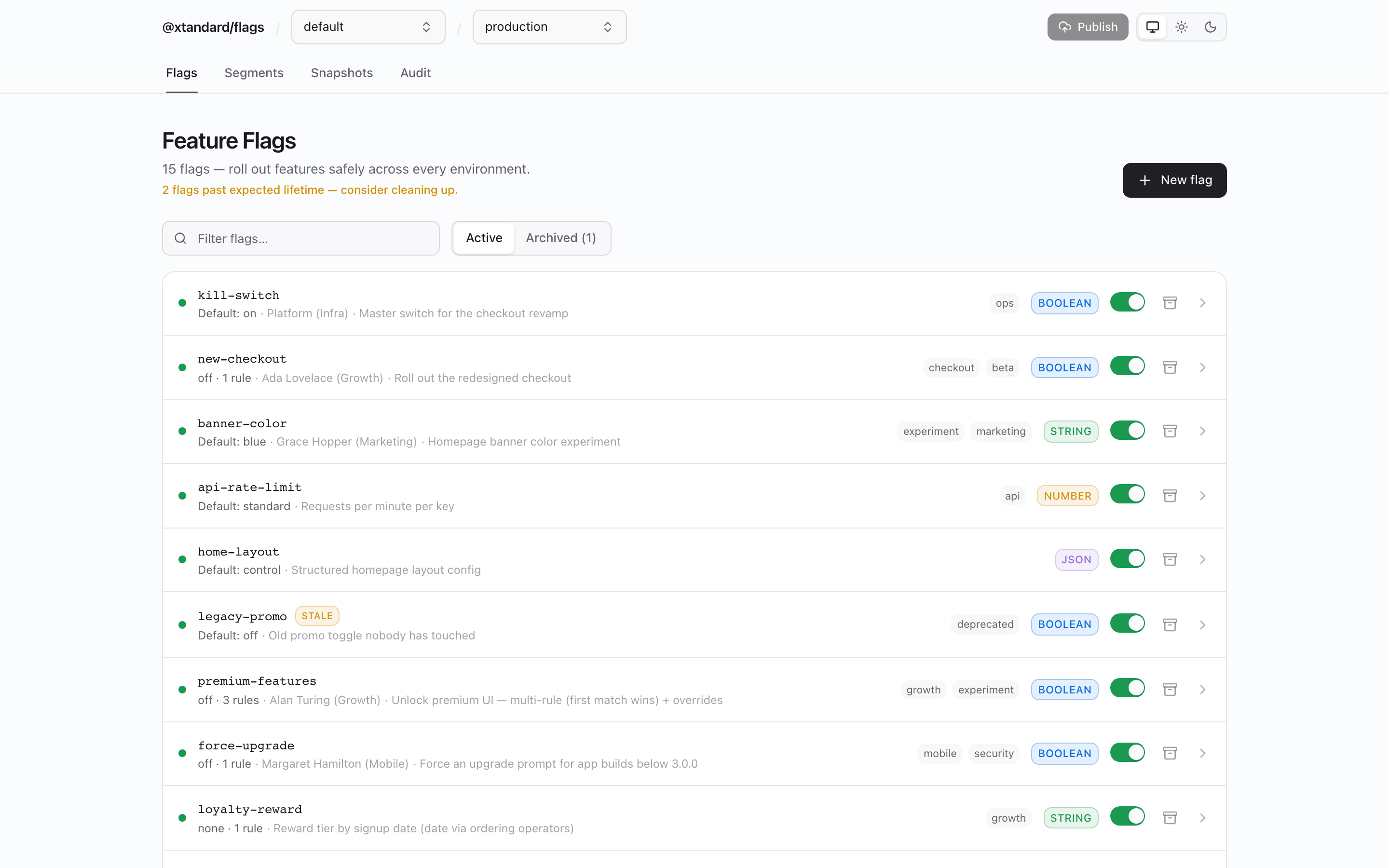
Your data, your infrastructure, no SaaS. A bundled admin SPA: mounting the panel does not make you install React.


npm install @xtandard/flagsRun it standalone (Docker or npx @xtandard/flags serve), embed the admin panel in the app
you already have (Elysia, Hono, Express, Bun, Next.js), or use its OpenFeature provider on its
own. One package: every integration is a subpath export whose dependencies are optional peer
dependencies, installed only when you use it.
Unleash, Flagsmith and GO Feature Flag are great, but most assume a server in (or near) the request
path and a heavier deployment. @xtandard/flags owns a narrower gap:
Self-hosted OpenFeature admin
Your data, your infrastructure, no SaaS. A bundled admin SPA: mounting the panel does not make you install React.
Pluggable storage
Memory, file, Redis, Postgres, MongoDB, SQLite, libSQL/Turso, Cloudflare KV, Drizzle or any unstorage driver. Bring your own with four methods.
Local-first evaluation
A tiny, zero-dependency evaluator and provider run in-process. Deterministic splits, never throws, keeps serving when the panel is offline.
Any language, a standard protocol
Other languages evaluate over OFREP: point any OpenFeature SDK’s generic OFREP provider at the panel. ETag/304 caching and an opt-in SSE stream.
It is intentionally not a LaunchDarkly clone: no experiment analytics, no hosted SaaS, no mandatory Redis, Postgres or auth. Batteries included, not required: everything official implements a public contract you can replace. Why & how it works →
import { Hono } from "hono";import { flagsPanel } from "@xtandard/flags/hono";import { createRedisStorage } from "@xtandard/flags/storage/redis";import { basicAuth } from "@xtandard/flags/auth/basic";
const app = new Hono();app.route(  "/flags",  flagsPanel({    basePath: "/flags",    sourceStorage: createRedisStorage({ url: process.env.REDIS_URL!, prefix: "flags:source" }),    runtimeStorage: createRedisStorage({ url: process.env.REDIS_URL!, prefix: "flags:runtime" }),    auth: basicAuth({      users: [{ username: "admin", passwordHash: process.env.FLAGS_ADMIN_PASSWORD_HASH! }],    }),  }),);export default app;
Open /flags, create a flag, and Publish: the draft compiles into an immutable snapshot in
runtime storage. Framework adapters →
import { OpenFeature } from "@openfeature/server-sdk";import { createOpenFeatureProvider } from "@xtandard/flags/openfeature";import { createRedisStorage } from "@xtandard/flags/storage/redis";
OpenFeature.setProvider(  createOpenFeatureProvider({    projectKey: "default",    environmentKey: "production",    storage: createRedisStorage({ url: process.env.REDIS_URL!, prefix: "flags:runtime" }),    refreshIntervalMs: 10_000,  }),);
const client = OpenFeature.getClient();const enabled = await client.getBooleanValue("new-checkout", false, {  targetingKey: user.id,  country: user.country,  plan: user.plan,});
The provider loads the whole snapshot once and evaluates from memory; a background refresh (poll or watch) picks up new publishes. OpenFeature provider →
import { OpenFeature } from "@openfeature/server-sdk";import { createOpenFeatureProvider } from "@xtandard/flags/openfeature";import { booleanFlag, createTestPanel, publishFlags } from "@xtandard/flags/testing";
const { core, runtimeStorage } = createTestPanel(); // in-memory source + runtime storesawait publishFlags(core, [  booleanFlag("new-checkout", {    rules: [      {        id: "pro-in-latam",        conditions: [          { attribute: "country", operator: "in", value: ["CO", "MX", "BR"] },          { attribute: "plan", operator: "equals", value: "pro" },        ],        serve: { variant: "on" },      },    ],  }),]);
await OpenFeature.setProviderAndWait(createOpenFeatureProvider({ storage: runtimeStorage }));const client = OpenFeature.getClient();await client.getBooleanDetails("new-checkout", false, {  targetingKey: "user-42",  country: "CO",  plan: "pro",}); // { value: true, variant: "on", reason: "TARGETING_MATCH", … }
No Redis, no server: @xtandard/flags/testing spins up an in-memory panel and builds flags
fluently. Testing →
# pip install openfeature-sdk openfeature-provider-ofrepfrom openfeature import apifrom openfeature.contrib.provider.ofrep import OFREPProvider
api.set_provider(OFREPProvider(base_url="https://flags.example.com"))enabled = api.get_client().get_boolean_value("new-checkout", False, ctx)
Go, Python, Rust, Java, .NET… evaluate over the OpenFeature Remote Evaluation Protocol, with no vendor SDK. Remote evaluation (OFREP) →
Two planes. The admin / control plane (UI, JSON API, CLI) edits drafts in source storage and publishes immutable snapshots to runtime storage. The application runtime loads a whole snapshot into memory and evaluates in-process, so the panel is never in the request path.
flowchart LR
  subgraph Admin["Admin / control plane"]
    direction TB
    UI["Admin UI · CLI"] --> API["JSON API<br/>auth · authorization · hooks"]
    API --> SRC[("Source storage<br/>drafts · history · audit")]
    API -- "publish → compile<br/>immutable snapshot" --> RT[("Runtime storage<br/>published snapshots")]
  end

  subgraph App["Your application (JS/TS)"]
    direction TB
    PROV["OpenFeature provider"] -- "load snapshot once" --> MEM[["In-memory snapshot"]]
    MEM --> EVAL["Evaluate in-process<br/>zero deps · never throws"]
  end

  subgraph Other["Other languages"]
    SDK["Any OpenFeature SDK<br/>+ OFREP provider"]
  end

  RT --> PROV
  PROV -. "refresh: poll or watch" .-> RT
  SDK -- "OFREP over HTTP<br/>ETag/304 · SSE" --> API
Every flag is variant-based, and evaluation follows a fixed order: enabled → schedule window → prerequisites → exact overrides → targeting rules (first match wins) → fallthrough. Splits are deterministic (MurmurHash3 on the flag key, the targeting key and a salt). The flag model →
@xtandard/flags is one of a family of open-source, MIT-licensed projects that share the xtandard
name. They are independent of each other: use any of them on its own.
All of them, with npm and GitHub links: the xtandard ecosystem.